If your work-based learning program isn't connected to industry-recognized credentials, you're leaving Perkins points — and student outcomes — on the table. Here's a practical, sector-by-sector guide to matching WBL placements to credential opportunities, building a credential map, funding exam fees, and moving your 5S1 numbers in the right direction.
If your work-based learning program isn't connected to IRCs, you're leaving Perkins points — and student outcomes — on the table.
Let's start with a scenario most CTE coordinators have lived through.
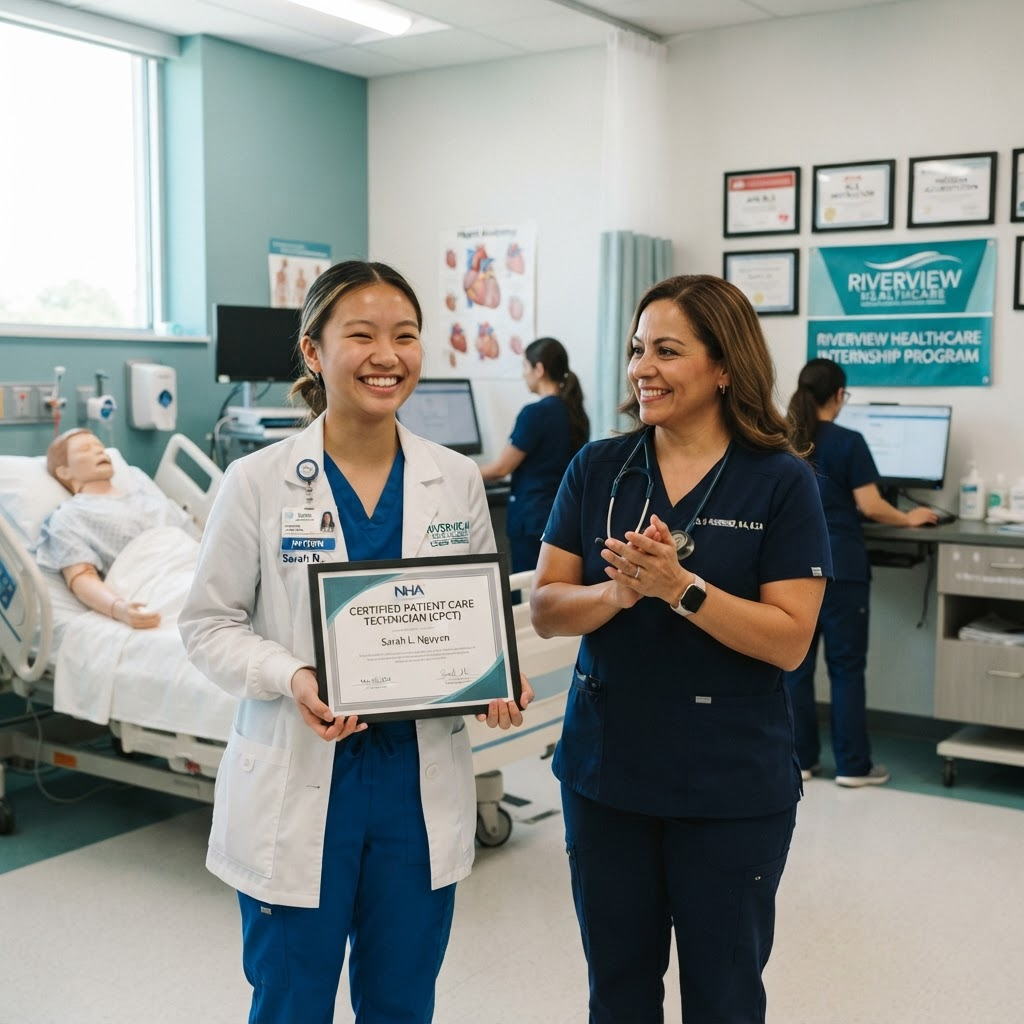
A student completes 200 hours of a healthcare internship. She's on-site three days a week, she's doing real clinical support work, her supervisor loves her, and she's planning to pursue nursing after graduation. By any measure, it's a successful WBL experience.
But when you sit down to report Perkins outcomes, you realize she doesn't count toward your 5S1 credential attainment indicator. She never sat for the Certified Nursing Assistant exam. Nobody connected those dots.
That's the gap this article is about.
Industry-recognized credentials — IRCs — are the portable, stackable, employer-validated certifications that turn a WBL experience from a resume line into a career launchpad. Getting systematic about connecting WBL placements to credential attainment is one of the highest-leverage moves a coordinator can make. It's better for students, it's better for employers, and it moves your Perkins numbers in the right direction.
Here's how to do it.
What Counts as an IRC (and What Doesn't)
Before you can align WBL to credentials, you need to know what the federal government and your state actually count.
Under Perkins V, an industry-recognized credential generally must be:
- Nationally recognized by employers in the relevant industry
- Portable across geographic regions and employers
- Stackable toward further education or higher-level credentials
- Validated through a third-party assessment or certification process
Examples that typically qualify:
- CompTIA A+, Network+, Security+ (IT/Cybersecurity)
- NCCER Core Curriculum Completion (Construction/Trades)
- Certified Nursing Assistant (CNA) (Healthcare)
- ServSafe Manager Certification (Hospitality/Food Service)
- OSHA-10 (Construction, Manufacturing — though state variance exists here)
- AWS Certified Cloud Practitioner (IT)
- Certified Logistics Associate (CLA) (Supply Chain)
- Adobe Certified Professional (Digital Media)
- ASE Student Certification (Automotive)
Examples that may not count (state-dependent):
- Internal company training certificates
- Locally developed skill badges not tied to a national body
- Driver's licenses or basic first aid (without additional occupational components)
- Course completion certificates (unless tied to an accredited program)
State variance is real. Your state maintains an approved IRC list for Perkins accountability purposes. Pull it. Bookmark it. The national picture and your state's list are not always the same. Credentials that count in one state may not in another.
Why WBL and Credentials Belong Together
WBL and credential attainment are often managed as separate tracks in CTE programs — the coordinator handles placements, the teacher handles industry exams. That silo is costing students outcomes.
Here's why the alignment matters:
For Students
WBL provides the applied context that makes credential content stick. A student who's been in a cybersecurity internship and actually configured a firewall is going to perform better on CompTIA Security+ than one who only studied a textbook. The WBL experience is the best exam prep that isn't called exam prep.
Credentials, in turn, transform WBL into something students can show. A 200-hour internship is listed on a resume. A CompTIA A+ certification is searchable in an employer's applicant tracking system. Both matter — but one is verifiable at scale.
For Employers
Employers increasingly use credential attainment as a screening tool. When you can tell a hiring manager that your WBL graduates come with a specific credential in hand, you've made their HR process easier. That makes your program stickier with employer partners and increases the likelihood they'll come back for the next cohort.
For Perkins Accountability
Perkins V Performance Indicator 5S1 measures the percentage of CTE concentrators who attain an industry-recognized credential or postsecondary credit. If students complete WBL without sitting for an associated credential, that time and experience doesn't register in your 5S1 numbers.
In most state Perkins plans, 5S1 is one of the indicators where programs are most likely to miss their negotiated targets. Systematic WBL-to-credential alignment is the most direct lever to move it.
The Alignment Framework: Matching WBL Experiences to Credential Opportunities
Not every WBL placement has a clean credential on-ramp. But more do than coordinators realize. Here's a sector-by-sector look at the most common alignments.
Healthcare
| WBL Experience | Credential Opportunity |
|---|---|
| Clinical internship (nursing/patient care) | CNA certification, CPCT/A (Phlebotomy), CMA (AAMA) |
| Dental office placement | DANB Radiation Health & Safety (RHS) |
| Emergency services / Fire/EMS internship | EMT-Basic (NREMT) |
| Healthcare administration / Medical office | CBCS (Medical Billing), CMAA (Medical Administrative) |
Key timing consideration: CNA exams require clinical hours that must be completed in an approved setting. If you're building a healthcare WBL pathway, coordinate with your state's nursing board on what site approvals are needed for clinical hours to count toward the exam.
Information Technology / Cybersecurity
| WBL Experience | Credential Opportunity |
|---|---|
| IT help desk / desktop support internship | CompTIA A+ |
| Network administration placement | CompTIA Network+ |
| Cybersecurity / SOC analyst internship | CompTIA Security+, Google Cybersecurity Certificate |
| Cloud/infrastructure placement | AWS Cloud Practitioner, Microsoft Azure Fundamentals (AZ-900) |
| Software development internship | CompTIA Linux+, Meta Front-End Developer Certificate |
Entry-level strategy: CompTIA has a pathway called the CompTIA Stackable Certifications framework — A+ → Network+ → Security+ — designed exactly for the CTE-to-workforce pipeline. Many WBL coordinators find that a student completing a tech internship while holding A+ already is dramatically more likely to convert to a full-time hire.
Construction & Skilled Trades
| WBL Experience | Credential Opportunity |
|---|---|
| General construction / carpentry | NCCER Core Curriculum, NCCER Carpentry Level 1 |
| Electrical pre-apprenticeship | NCCER Electrical Level 1, OSHA-10 Construction |
| Plumbing placement | NCCER Plumbing Level 1 |
| Manufacturing / CNC | NIMS Machining Level 1, MSSC CPT (Certified Production Technician) |
| Welding | AWS SENSE Level 1, Lincoln Electric School of Welding certifications |
OSHA-10 note: OSHA-10 is widely recognized by construction employers and increasingly shows up in job postings as a preferred qualification. It's a 10-hour course (available online or in-person) that can be completed during WBL prep. Whether it counts toward your state's Perkins IRC list is state-dependent — but it's worth pursuing regardless for employer relations.
Hospitality & Food Service
| WBL Experience | Credential Opportunity |
|---|---|
| Restaurant / food service placement | ServSafe Food Handler, ServSafe Manager |
| Hotel / lodging internship | AHLEI Hospitality Fundamentals, ServSafe Food Handler |
| Culinary placement | ProStart Certification (NRA) |
Business & Finance
| WBL Experience | Credential Opportunity |
|---|---|
| Accounting / bookkeeping internship | QuickBooks Certified User, NOCTI Business Math |
| Financial services placement | AFCPE AFC Exam Prep (for relevant pathways) |
| Marketing / social media internship | Google Analytics Certification, Meta Blueprint |
| Administrative / office internship | Microsoft Office Specialist (MOS) |
Building the Credential Map: A Process for Coordinators
If you've never systematically connected your WBL placements to credentials, start here.
Step 1: Audit Your Current Placements
Pull your WBL placement roster for the last two years. For each placement, note:
- Industry/sector
- Job tasks performed
- Whether the student earned any credential during or after the placement
Most coordinators who do this audit find that 20-40% of their placements have a natural credential alignment that was simply never pursued.
Step 2: Build a Pathway-to-Credential Matrix
Create a simple matrix that maps each of your CTE pathways to:
- The WBL site types you typically place in
- The credentials available in that sector
- Which credentials appear on your state's Perkins IRC list
- Whether your program has an approved testing center or access to one
Share this matrix with CTE teachers and counselors. Everyone should know which credentials students are pursuing and how WBL hours connect.
Step 3: Embed Credential Timelines into WBL Plans
Your WBL learning plan (whether paper or digital) should include a field for the target credential and the exam date. This does two things: it makes the credential goal explicit for the student and supervisor, and it creates a data trail you can report.
A student who writes "Pass CompTIA A+ by May 15" on her WBL learning plan is significantly more likely to actually sit for the exam than one who just shows up to the internship.
Step 4: Coordinate Exam Access and Funding
Exam fees are a real barrier, especially for students from low-income backgrounds. Before you tell students to pursue a credential, make sure you've mapped out how they'll pay for it:
- Perkins funds can be used for exam fees — check your state's allowable expenditure guidance
- Carl D. Perkins Career and Technical Education grants (local allocations) often explicitly allow student credential exam costs
- WIOA Youth Program funds (through your regional WDB) frequently cover exam fees for eligible youth
- Industry partners — many employers will pay the exam fee for a student they're interested in hiring; it's worth asking
- Scholarship programs — CompTIA, NCCER, and others have scholarship programs specifically for CTE students
WBL Tracker note: If your WBL management platform allows you to log credential targets and attainment dates alongside placement hours, use it. Being able to pull a report that shows "students with 100+ WBL hours had a 68% credential pass rate vs. 31% for students with under 50 hours" is compelling data for advisory committees, grant narratives, and state performance reviews.
Step 5: Train Your Employer Partners
This is the step most coordinators skip — and it's the one that has the highest leverage.
Employers who understand your credential goals will:
- Assign tasks that reinforce credential content (not just whatever they need done that day)
- Support student study time during slower periods
- Contribute to exam fee funding
- Mention the credential when they reference your program to other employers
A simple one-page document for employer supervisors — "Here's what credential [X] means, here's what your student is working toward, here's how you can help" — can meaningfully improve pass rates.
The Credential Attainment Conversation with Students
Students are much more motivated by credentials when they understand what they actually do. A lot of high schoolers have never heard of CompTIA or NCCER. They need to understand:
1. What the credential is. One sentence: what it certifies, who issues it, how many people hold it.
2. What it's worth in the local job market. Pull a specific job posting from Indeed or LinkedIn that lists the credential as preferred or required. Make it real and local.
3. What it leads to. Show the stackable pathway: A+ → Network+ → Security+. Students who see a credential as a step, not an endpoint, are more likely to pursue it.
4. That WBL experience gives them an edge. Students who've done the job understand the material differently than students who've only studied it. That's not a small thing — it's a genuine competitive advantage.
Tracking and Reporting Credential Attainment
For Perkins reporting purposes, you need to document:
- The student's name and ID
- The credential name and issuing body
- The date attained
- Verification (certificate number, testing platform record, etc.)
Collect credential documentation before the end of the school year — not after. Chasing transcripts from Certiport or CompTIA in July while you're trying to close out Perkins data is a headache you can avoid.
Build a simple credential verification request into your end-of-year student checkout process: "Before you leave, share a photo of your credential certificate or send me your Credly badge link."
Conclusion: Credentials Make WBL Count Twice
A well-designed WBL experience is already valuable. A well-designed WBL experience that ends with a student holding an industry-recognized credential is doubly valuable — to the student, to the employer, and to your program's Perkins performance record.
The work isn't glamorous. It's a matrix and a timeline and a conversation with a credential testing center and a line in a learning plan. But the cumulative effect — students who arrive at their first day of work with both the hours and the certification — is exactly the kind of outcome that makes CTE programs irreplaceable in a district.
Map the credentials. Embed them in the plan. Fund the exams. Track the attainment.
Your Perkins numbers — and your students' futures — will show the difference.
Action items for this week:
- Pull your state's approved Perkins IRC list and compare it to your current WBL placements
- Identify the top 3 credential opportunities that align with your highest-volume WBL sectors
- Add a "target credential / exam date" field to your WBL student learning plan
- Check with your Perkins coordinator on allowable expenditures for exam fees

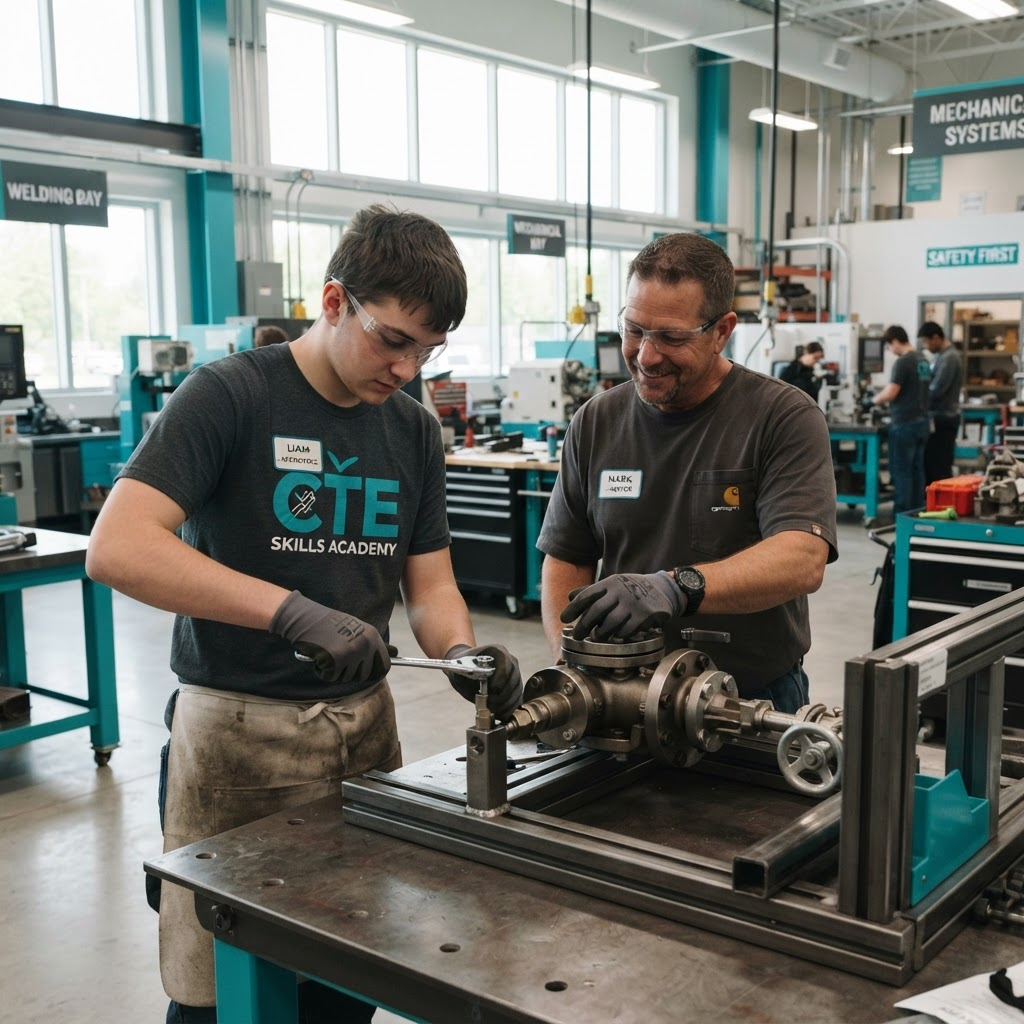
Students collaborating in a work-based learning environment
About the Author
WBL Tracker Team
Work-Based Learning Specialists
The WBL Tracker team consists of former educators and coordinators who understand the challenges of managing work-based learning programs. We're dedicated to helping schools save time and improve student outcomes.
Ready to Transform Your WBL Program?
Join coordinators who are saving 10+ hours per week with automated tracking and compliance reporting.